



You get up after a while sitting with your legs crossed, and there it is: the “dead” foot, that pins-and-needles tingling that makes you walk oddly for a few seconds. Almost everyone has felt it, and it’s almost always nothing. But when it keeps coming back, lingers or appears for no reason, that tingling stops being a passing anecdote and starts to be a message worth listening to.
Let’s tell the trivial apart from what deserves attention.
What does it mean for a foot to “fall asleep”?
The technical name is paraesthesia: abnormal sensations (tingling, numbness, burning, “pins and needles”) without a stimulus to justify them. They appear when the transmission of a nerve is disrupted.
The most common and most harmless cause is transient pressure: when you cross your legs, sit on a foot or wear tight shoes, you compress a nerve and its blood supply. Curiously, the tingling you feel as you release the pressure is precisely the sign that the nerve is “waking up”. Nothing to worry about.
The causes, from mild to serious
Not all persistent tingling is the same. These are the usual sources:
- Postural compression (the most frequent and benign): crossed legs, poor posture, tight or high-heeled footwear.
- Local nerve entrapments in the foot: Morton’s neuroma (pain and tingling between the toes, a feeling of a “stone in the shoe”) or tarsal tunnel syndrome (in the sole and the heel).
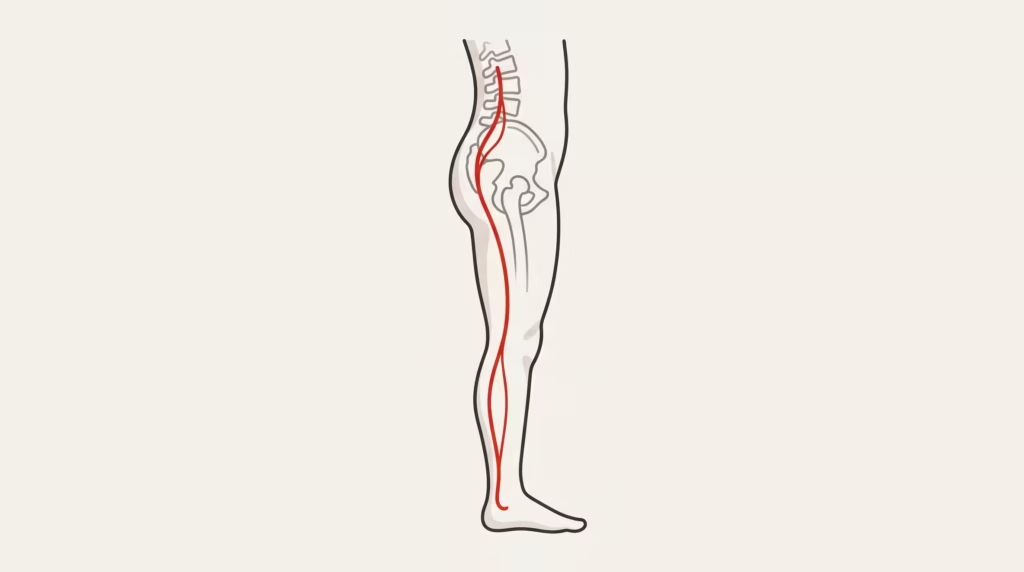
- Origin in the back: a lumbar disc herniation or sciatica can send tingling from the lower back or buttock all the way down to the foot and toes.
- Peripheral neuropathy: nerve damage, with diabetes as the most frequent cause (also alcohol or a vitamin B12 deficiency). It usually starts in both feet at once, in a “sock” pattern.
Did you know…? Diabetes is the most common cause of persistent tingling in the feet, and it’s often one of the first warning signs. That’s why numbness that appears in both feet and gets worse should never be ignored: a blood test is advisable.

How to work out where it’s coming from
The location gives plenty of clues (this points you in a direction, it doesn’t diagnose):
| Where you feel it | Possible source |
|---|---|
| One toe or between two toes | Local entrapment (e.g. Morton’s neuroma) |
| A whole foot, just one side | Tarsal tunnel, or a nerve from the back (sciatica) |
| Both feet, symmetrical | Neuropathy (diabetes, B12, alcohol) |
| Travels down from the back/buttock with pain | Lumbar radiculopathy / sciatica |
| Appears when crossing your legs or with certain footwear | Simple postural compression |
Warning signs: this means A&E
Most paraesthesias are not an emergency. But some combinations certainly are:
⚠️ Go to A&E if the tingling/numbness comes with:
- Loss of bladder or bowel control, or numbness in the genital or “saddle” area (possible cauda equina syndrome).
- Progressive weakness in one or both legs, or a foot drop (you struggle to lift the front of your foot).
- Sudden onset, especially if it affects one side of the body, with difficulty speaking, double vision or confusion.
- After a major injury to the back.
How it’s investigated
The doctor starts from your history and an examination (sensation, strength, reflexes). Depending on the suspicion, they may request a blood test (glucose, B12, thyroid) if thinking of neuropathy, nerve conduction studies/EMG to confirm an entrapment or neuropathy, or imaging (a lumbar MRI if a nerve from the back is suspected; an ultrasound of the foot for a neuroma).
Treatment: it depends on the cause

There’s no single treatment: you treat the source.
- Postural compression: correct your posture, don’t cross your legs as much, comfortable shoes in the right size.
- Entrapments (Morton’s, tarsal tunnel): appropriate footwear, insoles, physiotherapy, anti-inflammatories and, in stubborn cases, an injection or surgery.
- Sciatica / lumbar radiculopathy: conservative management with physiotherapy, exercise and, if needed, pain relief or an injection.
- Neuropathy (especially diabetic): the main thing is to control the cause (glucose in diabetes), care for your feet daily and, if there’s neuropathic pain, specific medication. A B12 deficiency is corrected with supplements.
When should you see someone?
Get it assessed if the tingling is persistent, recurrent or progressive; if it affects both feet; if it comes with pain, weakness or balance problems; if it makes walking difficult; or if it appears without a clear postural cause. An occasional dead foot is nothing; one that keeps coming back does deserve attention.
In short
Let’s go back to that dead foot after a while with your legs crossed. Now you know how to tell the difference: if it comes and goes when you change position, it’s the nerve “waking up”, and that’s that. But if the tingling lingers, appears in both feet or comes with weakness, it stops being an anecdote and becomes a warning your body is giving you to look at it calmly.
Listening to that signal in time is the best way to look after your nerves — and to keep moving without nasty surprises.
Do your feet often go numb? At Clínica QO (Alicante) we assess where the tingling comes from — posture, back or nerves —, advise you on when a referral makes sense, and treat what falls within our scope, in your language.
Frequently asked questions
Why do my feet go numb?
The most common reason is transient pressure on a nerve (crossed legs, tight shoes). If it’s persistent, it may come from an entrapment in the foot, a nerve from the back (sciatica) or a neuropathy, such as the one caused by diabetes.
Is tingling in the feet dangerous?
Almost never, but there are exceptions. Seek attention if it comes with loss of sphincter control, progressive weakness or foot drop, sudden onset with neurological symptoms, or after a blow to the back.
What does it mean for both feet to go numb at the same time?
Symmetrical tingling in both feet suggests a peripheral neuropathy, frequently due to diabetes (also a B12 deficiency or alcohol). A blood test and medical assessment are advisable.
Can foot tingling come from the back?
Yes. A lumbar disc herniation or sciatica can radiate tingling from the lower back or buttock down to the foot and toes, usually on just one side and often with back pain.
When should I see someone?
If the tingling is persistent, recurrent or progressive, affects both feet, comes with pain, weakness or loss of balance, or appears without a clear postural cause.
Sources and reference guides
- MedlinePlus (NIH) — Entumecimiento y hormigueo: https://medlineplus.gov/spanish/ency/article/003206.htm
- Mayo Clinic — Peripheral neuropathy: https://www.mayoclinic.org/diseases-conditions/peripheral-neuropathy/symptoms-causes/syc-20352061
- NICE — Neuropathic pain / diabetic neuropathy: https://www.nice.org.uk/
- Revisiones sobre neuroma de Morton y síndrome del túnel tarsiano, vía PubMed/NIH: https://pubmed.ncbi.nlm.nih.gov/