



The impact came from behind, at a traffic light, at low speed. In the moment, barely more than a fright and some broken glass. But the next morning the neck shows no mercy: stiff, sore, as if someone had stretched it sharply while you slept. Welcome to whiplash, one of the most common injuries – and the one surrounded by the most myths – after a road accident.
The good news, worth being clear about from the start: most cases of whiplash recover well. And what works best is not what many people think.
What exactly is whiplash?
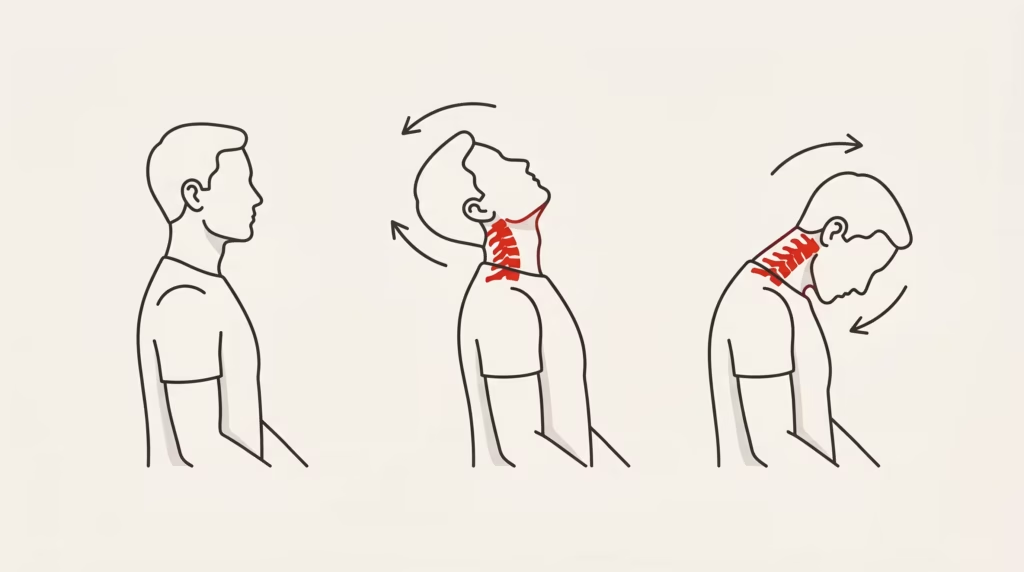
Whiplash (or a neck sprain) is an injury to the soft tissues of the neck – muscles, ligaments, sometimes nerves – caused by a sudden movement of acceleration and deceleration, like the crack of a whip. The neck shoots abruptly beyond its normal range and back again. The most typical cause is rear-end traffic collisions, although it also happens in falls or sporting knocks.
Is it serious? The Quebec classification, made simple
To grade the severity, the classification of the Quebec Task Force is used, with five grades:
| Grade | What happens |
|---|---|
| 0 | No neck pain or signs |
| I | Pain or stiffness, but no signs on examination |
| II | Pain + musculoskeletal signs (less mobility, tender points) |
| III | The above + neurological signs (reflexes, weakness, tingling) |
| IV | Cervical fracture or dislocation |
The great majority of cases are grade I and II: annoying, yes, but without serious injury. Grades III and IV are far less frequent and require specific care.

How it feels (and why it sometimes appears the next day)

A surprising detail: the symptoms are usually not immediate. It is very common for them to appear hours or even a couple of days after the accident. The most frequent:
- Pain and stiffness in the neck, which worsens when you move it.
- Headache, usually from the base of the skull.
- Dizziness or a sense of unsteadiness.
- Radiating pain to the shoulders, upper back or arms.
- Sometimes: fatigue, blurred vision, ringing in the ears, difficulty concentrating or sleeping, irritability.
Did you know…? The pain appearing the next day does not mean the injury is more serious. It is the normal course of whiplash: the inflammation of the tissues takes a few hours to show itself. Don’t be alarmed by the delay, but do watch out for the warning signs.
Warning signs: when to go to A&E
Most cases of whiplash are mild, but a serious injury must be ruled out. Professionals use validated rules (such as the Canadian C-Spine Rule) to decide whether an X-ray is needed.
⚠️ Seek urgent medical attention if there is:
- Very intense pain that does not ease.
- Tingling or numbness in the arms, hands or legs.
- Weakness in the arms or legs.
- A dangerous mechanism (high speed, a fall of more than a metre).
- Age of 65 or over.
- Inability to turn the head 45° to each side.
The diagnosis: clinical, without X-rays “just in case”
The diagnosis of whiplash is, above all, clinical: the history of the accident and the physical examination. Imaging tests (X-ray, CT, MRI) are not done routinely; they are reserved for when there are warning signs that raise suspicion of a fracture or another serious injury. Requesting imaging without indication adds nothing and only creates unnecessary worry.
The treatment that works: move, don’t immobilise
Here is the most important shift in mindset, and it is very well supported by the evidence.
- Staying active is the key. The main recommendation is to carry on with your normal life as far as the pain allows (“act-as-usual”). Prolonged rest delays recovery.
- Early movement and physiotherapy. Neck exercises prescribed by a professional reduce pain and restore function. Manual therapy can be added within a complete plan.
- The neck collar, advised against. This surprises many people: the evidence (including Cochrane reviews) is clear that the routine soft collar is counterproductive – more stiffness, more pain, slower recovery. If used at all, it should be for very little time and in very specific cases.
- Pain relief on occasion (paracetamol or anti-inflammatories) to control the pain while you move.
Quick summary – what helps and what to avoid
| Helps | Better avoided |
|---|---|
| Carrying on with your normal life, calmly | Routine neck collar |
| Early neck exercise | Prolonged rest |
| Physiotherapy and manual therapy | X-rays “just in case” |
| Understanding that pain is not serious damage | Keeping still out of fear |
Prognosis: good for most, with one caveat
Most people improve notably in the first weeks or months. But let’s be honest: a subgroup (the figures vary quite a bit, around 15–40%) can develop persistent pain, what is called chronic whiplash. What increases that risk? Above all a very intense initial pain, a large limitation at the start, neurological symptoms and psychological factors such as fear of movement or very negative expectations.
The good news is that many of those factors can be worked on: moving early, understanding that pain does not equal damage, and not letting yourself be paralysed by fear are, in themselves, part of the treatment.
In summary
Let’s go back to that morning of a seized-up neck after the knock at the traffic light. Now you know that the initial fright rarely corresponds to anything serious, that pain arriving late is normal, and – most usefully – that the best medicine is not keeping still with a collar, but moving sensibly, watching for the warning signs and letting yourself be guided.
The neck is more resilient than it seems after a fright. Treating it as an area that should return to movement, and not as a broken part, is what makes the difference between recovering in weeks or dragging it out for months.
Whiplash after an accident? At Clínica QO (Alicante) we assess your neck, rule out what matters and guide you with an active plan to recover as soon as possible – in your language.
Frequently asked questions
How long does whiplash take to heal?
Most people improve notably within weeks or a few months. A subgroup can develop persistent pain, especially if the initial pain was very intense or there is a lot of fear of movement.
Why did my neck start hurting the next day?
This is normal with whiplash: the symptoms usually appear hours or days later, because the inflammation of the tissues takes time to show itself. The delay does not indicate greater severity.
Should I wear a neck collar?
Generally, no. The evidence advises against the routine collar because it can worsen stiffness and delay recovery. It is better to stay active and do early exercise guided by a professional.
Do I need an X-ray?
Not routinely. The diagnosis is clinical; imaging is reserved for when there are warning signs that raise suspicion of a fracture or another serious injury.
When should I go to A&E?
If you have very intense pain, tingling or weakness in the arms or legs, you cannot turn your head, the accident was at high speed, or you are 65 or older. These are criteria for ruling out a serious injury.
Which treatment works best?
Staying active, early neck exercise and physiotherapy, with occasional pain relief if needed. Moving sensibly works better than immobilising.
Sources and reference guides
- Spitzer WO et al. — Quebec Task Force on Whiplash-Associated Disorders (clasificación WAD): https://pubmed.ncbi.nlm.nih.gov/
- Guidelines for the management of WAD (NSW/MAA, Australia): https://www.sira.nsw.gov.au/
- Cochrane Library — collar vs. active mobilisation en latigazo: https://www.cochranelibrary.com/
- Stiell IG et al. — Canadian C-Spine Rule: https://pubmed.ncbi.nlm.nih.gov/