


You get up from the couch just like any other afternoon. And then it happens: an electric jolt starts in your buttock and shoots down the back of your leg, as if someone had flipped a switch you didn’t even know you had. You stop halfway, one hand on your back, holding your breath. This isn’t just any muscle strain. It’s that pain so many people describe with the same word, almost always in a hushed voice and with a look of fear on their faces: sciatica.
If you’ve come this far looking for answers, the first thing to know is this: most cases of sciatica get better—and they do so without surgery. But to make a full recovery, it’s important to understand what’s really going on, which symptoms you shouldn’t ignore, and what to do today. Let’s take it one step at a time.
What is sciatica (and why isn’t it a diagnosis)?
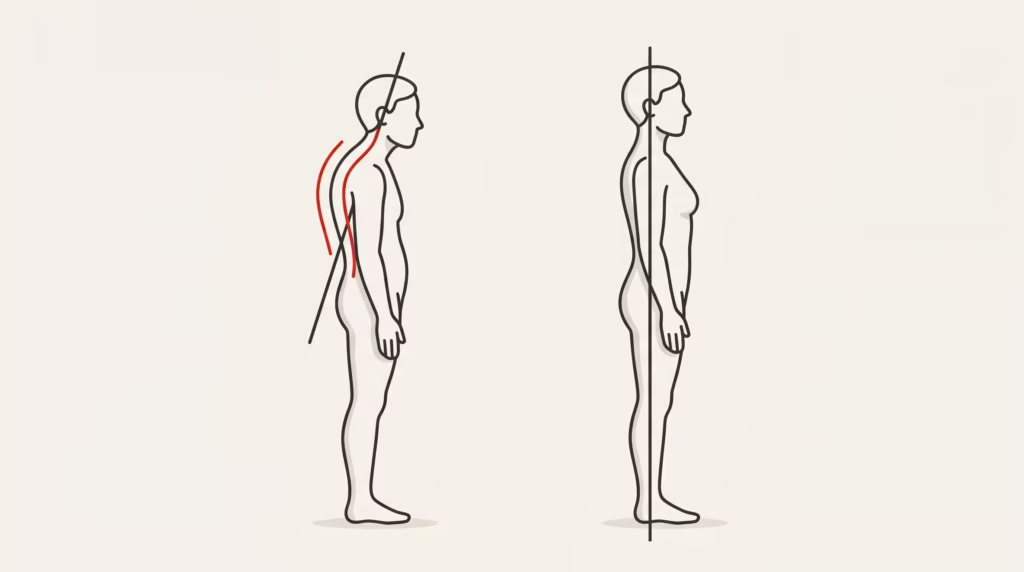
Here’s the first surprise: sciatica isn’t a disease. It’s a symptom. It’s the name we give to the pain that travels along the sciatic nerve—the longest and thickest nerve in your entire body, which in some places is almost as wide as your little finger. That nerve originates from the junction of several nerve roots in the lumbar and sacral regions (levels L4, L5, S1, S2, and S3), runs through the buttock, and descends along the back of each leg to the foot.
When something irritates or compresses that nerve or its roots, the characteristic pain sets in. That’s why saying “I have sciatica” is like saying “I have a fever”: it describes what you’re feeling, not the cause. And the cause is exactly what needs to be identified in order to treat you properly. That difference—which may seem like a subtle distinction—changes everything: you don’t treat sciatica “in general”; you treat the specific problem that’s causing it.
Did you know…? The sciatic nerve is so long that it connects your lower back to the sole of your foot. That’s why a problem in your lower back can cause tingling in your toes, even if your foot is perfectly healthy.
Why Does It Happen? The Most Common Causes
🎬 Promotional video
In the vast majority of cases, sciatica originates in the lumbar spine. The most common cause is a herniated disc: one of the discs that cushions your vertebrae slips out of place or ruptures, and its contents press on a nerve root. It is estimated that about 85% of sciatica cases are related to a disc problem, especially among people aged 30 to 50.
But that’s not the only explanation. These are the most common ones:
| Reason | Who It Typically Affects | Typical track |
|---|---|---|
| Lumbar Disc Herniation | Adults aged 30–50 | Pain that gets worse when sitting, coughing, or sneezing |
| Lumbar spinal stenosis | Older Adults | Discomfort when walking or standing for a while; relief when bending over |
| Spondylolisthesis | Variable | One vertebra “slips” over another and pinches the nerve |
| Pyriformis Syndrome | Less common | A deep gluteal muscle is compressing the nerve |
The good news is that, whatever the cause, the road to recovery is pretty much the same in the most common cases. The bad news—let’s be honest—is that none of them get better on their own overnight. It takes some patience and, above all, staying active.

How does it feel? Symptoms and typical pattern
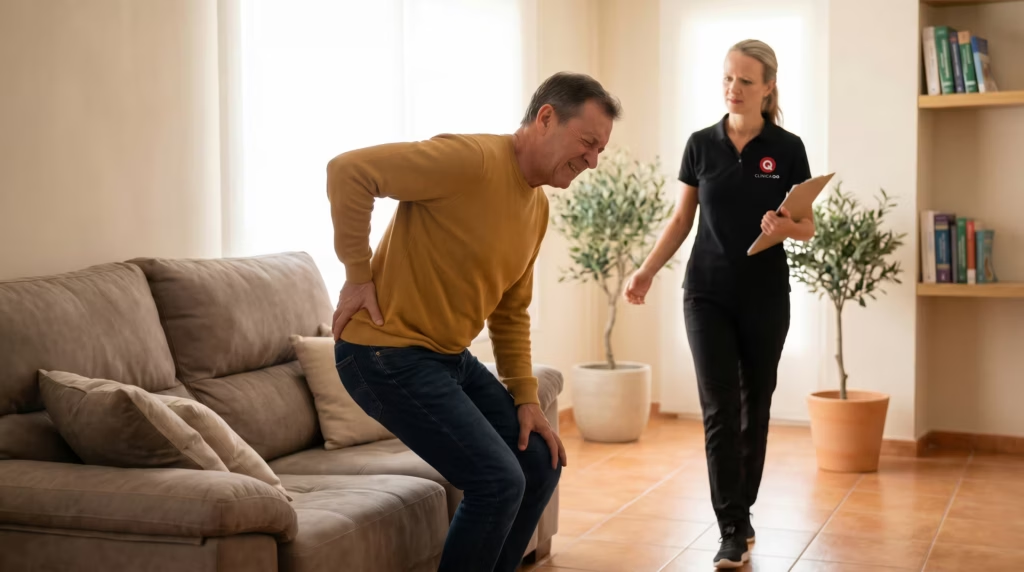
Sciatica has a fairly distinctive “pattern.” It almost always affects only one side of the body, and the pain follows the path of the nerve:
- It starts in the lower back or the buttocks.
- It runs down the back or side of the thigh and leg.
- It can reach all the way down to the foot and toes.
The pain varies greatly from person to person: from a dull, constant ache to a sharp, burning, cramp-like pain. It is often accompanied by other sensations in the affected leg: tingling, like pins and needles; numbness or loss of sensation; and, in some cases, muscle weakness (for example, difficulty lifting the foot while walking).
There are certain actions that give sciatica away because they suddenly make it worse: coughing, sneezing, laughing hard, or sitting for too long. If this sounds familiar, you’re not imagining things—it’s the classic pattern.
Warning Signs: When It’s an Emergency
Let’s get serious for a moment. The vast majority of cases ofsciatica are not emergencies. However, there is a rare and serious condition —cauda equina syndrome—in which the nerves at the end of the spinal cord are severely compressed. It requires urgent care to prevent permanent damage.
⚠️ Go to the emergency room immediately if you notice:
- Loss of bladder or bowel control (leaks you didn’t have before).
- Numbness in the “saddle” area: genitals, perineum, and inner thighs.
- Significant weakness or rapidly worsening weakness in both legs.
- A sudden, intense pain accompanied by any of the above symptoms.
A “drooping foot” that’s getting worse—where it becomes increasingly difficult to lift the tip of your foot—also warrants an immediate visit to the doctor. These cases are the exception, not the rule, but it’s good to be aware of them. If you’re unsure, see a doctor: it’s better to make one extra visit than to overlook a serious symptom.
What Really Works? Evidence-Based Treatment
This is probably the part you came here to read. And here’s a piece of news that surprises a lot of people: what was recommended for decades—complete bed rest—is now discouraged. Stayinginbed can even slow down your recovery.
Leading clinical guidelines, such as the British NICE (NG59), point in a clear direction:
- Stay active. Continue with your normal life as much as possible. A Cochrane review concluded that recommending physical activity does no harm and is, at the very least, no worse than bed rest.
- Exercise and physical therapy. An exercise program designed by a professional is one of the cornerstones: it aims to strengthen the core, improve mobility, and correct posture.
- Manual therapy (mobilization, manipulation), ideally combined with exercise, not as a substitute for it.
- Pain relievers such as anti-inflammatory drugs, at the lowest effective dose and for the shortest possible time. It is important to note that the evidence regarding their effectiveness for sciatica is limited.
Regarding chiropractic and osteopathy: the evidence for manual therapy in treating sciatica is mixed and is still being studied. It has its place as part of a combined approach—hands-on treatment plus exercise plus education—but be wary of anyone who promises you a miracle cure in a single session. Honesty is also part of the treatment.
Quick Summary — What Helps and What to Avoid
| Yes, it helps | Best to avoid |
|---|---|
| Keep moving within your limits | Complete bed rest |
| Walk often, in short stretches | Sitting for hours at a time |
| Guided and Progressive Exercise | Lifting weights “the hard way” |
| Gentle heat to help you relax | Waiting for the pain to “see if it goes away” |
Our Approach at Clínica QO (Alicante)
In our practice, we see cases of sciatica almost every week, and they rarely resemble one another. That’s why the first step isn’t the treatment table—it’s listening to you and exploring your symptoms. We want to understand when your pain starts, what triggers it, how far down it travels, and what you need to be able to do again without fear—driving, sleeping on your good side, playing with your kids on the floor.
From there, we follow evidence-based recommendations: manual therapy to relieve pain and restore mobility, progressive exercise to ensure long-term improvement, and postural reeducation to reduce relapses. And if we detect any red flags, we refer you right away—knowing when it’s not our job is also part of doing it right.
A benefit for many of our international patients in the area: we can assist you in your own language. Here, we understand how important it is to be able to describe your pain in your own words.
When is an injection or surgery considered?
The vast majority never reach this point, but it’s good to have the full picture. It’s worth taking that extra step when:
- Warning signs appear (cauda equina syndrome): in such cases, surgery may be urgent.
- The pain is severe and persists despite proper conservative treatment, usually lasting longer than 6–8 weeks.
- There is a progressive neurological deficit, such as weakness that gets worse over time.
Among the options, epidural injections can provide short-term relief by reducing inflammation around the nerve, although their long-term benefits are less clear. And surgery (for example, a microdiscectomy to remove the portion of the disc that is compressing the nerve) is reserved for cases where it is warranted. The decision is always individualized and is made by the specialist in consultation with you—not by an article on the internet.
Prognosis and Prevention
Let’s end with what matters most: the future. And here, the message is an optimistic one. Most people with sciatica show significant improvement within 4 to 8 weeks with active management. Many never need surgery.
The “but” is an honest one: relapses are common. That’s why prevention isn’t an afterthought—it’s part of the treatment. Maintaining an exercise routine, being mindful of how you sit and lift weights, and not stopping your exercises as soon as the pain goes away are the best ways to prevent the next episode.
Did you know…? Spending many hours sitting is one of the main causes of sciatica. Here’s a simple, evidence-based tip: get up and walk around for a couple of minutes every half hour. Your lumbar disc will thank you for it.
In summary
Let’s go back to that afternoon, to the sharp pain that left you halfway up from the couch. Now you know that this pain isn’t a punishment or a sentence—it’s a warning sign. Your body is warning you that something in your lower back needs attention. Sciatica, in most cases, is a story with a happy ending—as long as you recognize the warning signs, stay active, and seek professional help when you need it.
If you’ve been struggling with that pain running down your leg for days, you don’t have to figure out what to do on your own. A thorough evaluation can save you weeks of uncertainty.
Is sciatica holding you back? At Clínica QO (Alicante), we assess your case, explain what’s going on, and design a personalized plan for you—in your language.
Frequently Asked Questions
How long does sciatica last?
Most cases improve significantly within about 4 to 8 weeks with conservative treatment and by staying active. Some cases resolve sooner, and others take longer, but the overall outlook is good.
Can I or should I exercise if I have sciatica?
Yes, as long as your pain allows it. Complete bed rest is not recommended. Walking and a guided exercise program are part of the treatment; ideally, a professional should advise you on what to do and what to avoid at this stage.
Is it better to stay in bed for a few days?
No. Current guidelines advise against prolonged bed rest because it can delay recovery. It’s better to move gently and frequently, avoiding only movements that trigger pain.
Do chiropractic or osteopathic treatments help with sciatica?
Manual therapy can be part of a combined approach that includes exercise and education, and many people find relief. That said, the evidence is mixed, and it’s best to be skeptical of promises of an immediate cure in a single session.
When should I go to the emergency room?
If you lose control of your bladder or bowels, notice numbness in your genital area or inner thighs, or feel significant or progressive weakness in both legs, these are warning signs that require immediate attention.
Can sciatica be cured without surgery?
In the vast majority of cases, yes. Surgery is reserved for warning signs, such as severe pain that does not subside after weeks of conservative treatment or a neurological deficit that is getting worse.
Sources and Reference Guides
- NICE — Low Back Pain and Sciatica in People Over 16 (NG59): https://www.nice.org.uk/guidance/ng59
- Cochrane Library — reviews on activity vs. rest and NSAIDs for sciatica: https://www.cochranelibrary.com/
- MedlinePlus (NIH) — Sciatica: https://medlineplus.gov/spanish/sciatica.html
- Mayo Clinic — Sciatica: https://www.mayoclinic.org/diseases-conditions/sciatica/symptoms-causes/syc-20377435